Table of Contents
Mugshot publishing sits at the intersection of public records, journalism, and lasting harm. In the digital age, a single booking photo posted online can follow someone for years, regardless of guilt, conviction, or case outcome.
Names are the weakest link in this system. Case numbers are the only defensible ones.
If publishers, media outlets, and mugshot websites want accuracy, legal protection, and credibility, case numbers must come before names.
Mugshot Publishing Was Built for Speed, Not Precision
Mugshot publishing grew out of public records access. Law enforcement agencies release police booking photos. County jails log arrests. News media and mugshot sites pull those images and post them online, often within hours.
That speed drives web traffic. It also creates mistakes.
A name is not a unique identifier. In many communities, dozens of people share the same name. When booking, photos are published solely by name, making misidentification inevitable.
The criminal justice system does not rely on names to track cases. It relies on case numbers. Publishers who ignore that reality take on unnecessary risk.
What a Case Number Actually Does
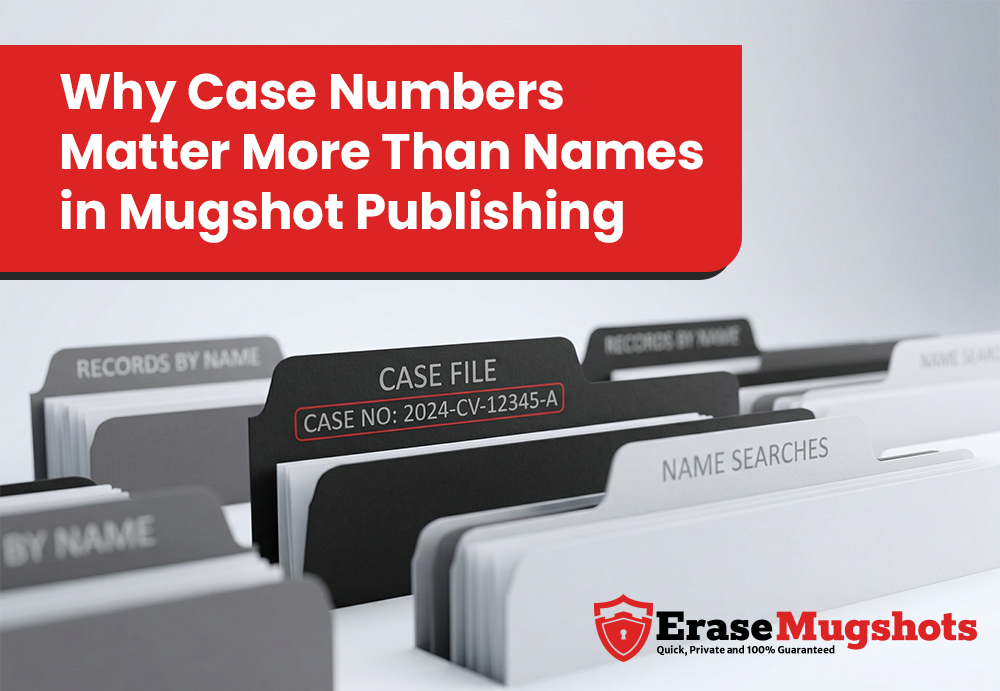
A case number is the spine of a criminal case. It connects arrest records, criminal charges, court filings, prosecutors’ actions, and final outcomes.
Names change. Spellings vary. Middle initials disappear. Case numbers do not.
When publishers use case numbers:
- They can confirm whether charges were filed or dropped
- They can track whether someone was found guilty or found innocent
- They can update or remove mugshots when cases resolve
Without a case number, a mugshot is just an image detached from its legal context.
The Harm of Name-Based Mugshot Publishing
Mugshots create a powerful visual association between a person and crime. That association forms instantly in search results and lingers indefinitely.
For people who are innocent, accused but not convicted, or whose charges were dropped, the harm is real:
- Job opportunities disappear
- Housing applications fail
- Social relationships suffer
- Internet search results become permanent barriers
Studies show that having a criminal record can cut employment chances in half. Mugshots amplify that damage, even when no conviction exists.
Sociologist Sarah Lageson, who studies the mugshot industry, has documented how people feel revictimized by the continued presence of booking photos online. The image becomes more powerful than the outcome.
Mugshot Extortion Thrives on Weak Identifiers
Many mugshot websites profit from confusion. Images are posted online, ranked aggressively on Google, and paired with removal fees that can reach thousands of dollars.
The American Bar Association has described this ecosystem as an online extortion scheme.
Name-based publishing fuels that model. When a mugshot cannot be easily verified or disproven, people feel trapped. They pay to make it go away.
Case numbers disrupt that cycle. They introduce accountability. They enable verifying records, requesting corrections, and requiring removal when appropriate.
Why Media Outlets Are Changing Their Policies
Many news outlets have already recognized the damage caused by indiscriminately publishing mug shots.
The New York Times, Washington Post, and dozens of local newsrooms now limit mugshot use to certain circumstances, such as active public safety concerns or serious crimes.
Journalists increasingly cite the ethical duty to minimize harm. Publishing booking photos for low-level arrests or cases without conviction rarely serves the public interest.
Law professor Thomas Keesee has argued that the presumption of innocence collapses the moment a mugshot is posted online. The image becomes the story.
Case numbers allow journalists to report responsibly without turning arrest photos into permanent punishment.
Law Enforcement Is Pulling Back Too
Some law enforcement agencies have begun to reconsider whether releasing mugshots serves any legitimate purpose.
- New York banned routine mugshot release unless it helps law enforcement
- California prohibited police from posting mugshots on social media
- Utah barred publishing mugshots until after conviction
- The Justice Department refuses to release federal mugshots, citing no public safety benefit
These shifts reflect a growing recognition that booking photos creates harm disproportionate to their value.
Legal Risk Lives in the Gaps
Mugshots are often considered public records. That makes lawsuits difficult, but not impossible.
Publishers face exposure when:
- The wrong person is identified
- A case outcome is ignored
- A mugshot remains posted after expungement
- Removal fees are charged improperly
Courts have shown increasing concern that posting mugshots of pretrial detainees may amount to unconstitutional pretrial punishment.
Case numbers help publishers prove accuracy, intent, and good faith. Names do not.
Racial Bias and Disproportionate Impact
Widespread mugshot publishing has been shown to reinforce racial bias. Booking photos disproportionately affect Black people and other marginalized groups, distorting public perception of criminality.
When mugshots are posted without context or outcome, they become tools of misrepresentation.
Responsible publishing requires precision. Case numbers provide it.
Why Case Numbers Protect Publishers
From a publisher’s standpoint, case numbers do three critical things:
- They tie images to verified public records
- They allow for updates, corrections, and removals
- They reduce defamation and privacy claims
Many states have now introduced or passed laws banning removal fees and regulating mugshot publishing. The proposed Accountability in Mugshot Publishing Act would establish national standards, including mandatory takedowns for expunged records.
Publishers who rely on names alone will not age well under these changes.
The Role of Google and Search Results
Mugshot websites often rank because they are optimized for search. Once indexed, a booking photo can dominate search results for years.
Case numbers give readers a way to verify what they are seeing. Names do not.
In an internet that never forgets, precision matters more than speed.
A Better Standard Going Forward
Case numbers should be the minimum requirement for publishing booking photos.
They allow:
- Accurate identification
- Clear tracking of case outcomes
- Ethical reporting
- Reduced harm to innocent people
They align with evolving journalism standards, legal scrutiny, and public expectations.
Mugshot publishing is not going away. But it does not have to remain reckless.
Precision is the difference between public information and permanent damage.
Names are easy.
Case numbers are responsible.
See What Shows Up When Someone Searches Your Name
Get a free, no-obligation analysis of your exposure — mugshots, arrest records, and everything else a background check might turn up.