Table of Contents
People often use “legal relief” and “search relief” as if they mean the same thing. However, they don’t. Mixing them up can create false expectations, bad advice, and real risk for individuals, businesses, and organizations trying to address harm.
The difference matters greatly, especially when reputation, housing, employment, immigration status, or family stability is involved.
This guide explains the difference in plain language, with real examples, and without legal jargon.
What Legal Relief Actually Means
Legal relief is what a court can order under the law.
It originates from a judge.
It follows a formal legal process.
Moreover, it creates enforceable rights and obligations.
Legal relief exists to address a violation of the law. That could involve housing, domestic violence, family law, immigration, bankruptcy, welfare access, or civil rights.
Common forms of legal relief include:
- Monetary relief, such as damages or restitution
- Equitable remedies like injunctions or court orders to stop harm
- Declaratory remedies that clarify legal rights
- Court judgments that affect future conduct
Legal relief generally requires:
- A plaintiff or party filing in court
- Proper court forms and procedures
- An attorney, legal aid organization, or self-help center
- A judge deciding
For many people, access comes through civil legal aid, legal aid services, a legal aid society, or a legal aid foundation. These organizations, often supported by government funding, bar associations, and pro bono projects, help protect rights when people cannot afford private lawyers.
Examples include:
- A tenant facing eviction seeking legal aid services for housing protection
- A survivor of abuse is working with a legal aid organization for a protective order
- A veteran accessing pro bono legal help for benefits or discharge status
- A family seeking help through family law services during divorce or custody disputes
Legal relief is formal, slow, and binding.
What Search Relief Means (And What It Is Not)
Search relief, on the other hand, is not a legal remedy.
It is not ordered by a court.
It does not come from a judge.
Nor does it resolve legal rights.
Search relief refers to reducing harm caused by online search results.
That harm might arise from:
- Outdated court records rank high in search results
- Arrest information with no conviction
- News articles are missing context or updates
- Mugshot pages that follow a person for years
- Content that is technically true but misleading
Search relief focuses on how information appears, ranks, or spreads online, rather than whether it is legal or illegal.
Common search relief actions include:
- Requesting corrections or updates on publisher sites
- Removing content that violates platform policies
- De-indexing pages from search engines
- Suppressing harmful pages with accurate replacement content
- Helping clients regain control of how they are perceived
Search relief is handled through:
- Platform policies
- Publisher outreach
- Documentation and verification
- Technical SEO and content strategy
No court order is required.
No attorney is required.
However, accuracy, documentation, and restraint are critical.
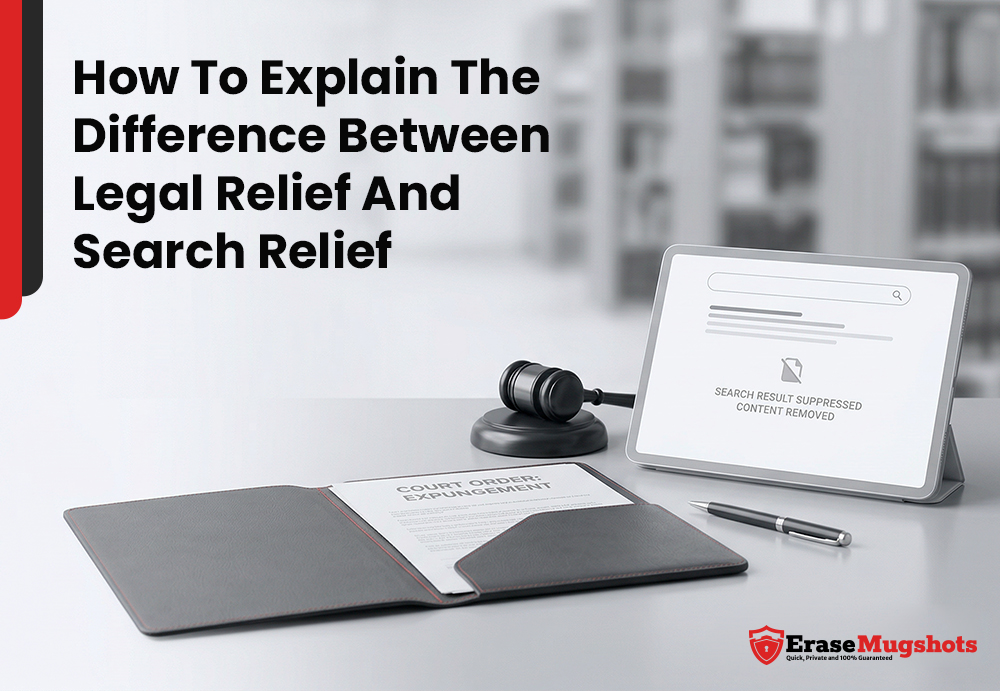
The Core Difference in Plain Terms
Here is the simplest way to explain it:
- Legal relief fixes a legal problem
- Search relief fixes a visibility problem
Legal relief addresses lawful authority.
Search relief addresses public perception.
Legal relief changes what someone is legally allowed to do.
Search relief changes what people see when they search for a name.
They can overlap. Yet, they are not interchangeable.
Why Confusing Them Causes Problems
Confusion leads to risk.
If someone promises “legal relief” when they mean search suppression, they may be accused of misrepresentation.
If a client expects a court outcome from search work, trust breaks down.
Furthermore, if legal aid organizations or advocacy groups blur the terms, vulnerable people may delay real legal help.
This is especially serious in cases involving:
- Domestic violence
- Immigration and citizenship
- Child custody
- Veterans’ benefits
- Housing insecurity
- Bankruptcy or welfare access
Search relief cannot replace:
- A protective order
- A court judgment
- Immigration status relief
- Family law decisions
And legal relief cannot automatically clean up search results.
When Legal Relief Is the Right Path
Legal relief is appropriate when:
- A law has been violated
- A party needs enforceable protection
- Monetary damages are necessary
- A court must determine rights
Examples:
- An eviction case handled through legal aid services
- A domestic violence survivor seeking a restraining order
- A family law dispute over custody or support
- A bankruptcy filing to stop collection actions
In these cases, people should seek:
- Legal aid organizations
- Pro bono lawyers
- Bar association referral programs
- Self-help centers with court access
Search work alone is not enough.
When Search Relief Is the Right Path
Search relief is appropriate when:
- Information is outdated but accurate
- No law was violated
- The harm is reputational, not legal
- The goal is future impact, not punishment
Examples:
- An old arrest page appears during job searches
- News coverage is missing later corrections
- Mugshot sites ranking above official records
- A resolved case is still defining online identity
Here, the focus is on:
- Context
- Accuracy
- Visibility
- Fair representation
Legal aid may not apply. Courts may not help. Yet, search relief can still reduce harm.
When Both Are Needed
Sometimes the correct approach is both.
A person may:
- Pursue legal relief through the court
- While also addressing how the issue appears online
Example:
A victim of abuse secures a court order through legal aid.
However, outdated articles still surface.
Search and relief help prevent ongoing harm while legal protection remains in place.
This is where coordination matters. Not confusion.
How To Explain This To Clients or the Public
Use simple language.
You can say:
- “A court can give you legal relief.”
- “Search relief changes how information shows up online.”
- “One affects your rights. The other affects perception.”
Avoid:
- Calling search work “legal action.”
- Promising legal outcomes without an attorney
- Using court language for non-court processes
Accuracy protects everyone involved.
The Role of Legal Aid and Advocacy Organizations
Legal aid organizations and advocacy groups play a crucial role in helping individuals access legal relief. They provide legal services specifically tailored to vulnerable populations, including victims of domestic violence, immigrants, veterans, and low-income families. These organizations often partner with government agencies, bar associations, and pro bono lawyers to expand access to justice.
For example, in the Bay Area, legal aid societies collaborate with volunteer lawyers and community partners to offer free or low-cost counsel. Similarly, in Northeastern New York, organizations like Pro Bono Net provide resources and support to connect clients with qualified attorneys. These partnerships ensure that people receive not only legal advice but also assistance in navigating court procedures and accessing necessary court forms.
Legal aid offices also offer self-help centers and online resources to empower individuals who cannot afford full legal representation. By providing clear information and guidance, these offices help clients understand their rights and the legal relief options available to them.
Understanding the Broader Context: International Law and Human Rights
While this guide focuses on legal relief within a domestic context, it is important to recognize that international law and human rights frameworks also establish rights to effective remedies. Many countries and international bodies emphasize that where a right is violated, there must be accessible and effective legal relief.
This principle supports the idea that legal remedies are fundamental to upholding justice globally. It also underscores the importance of ensuring that legal aid services are available to all, regardless of circumstances, nationality, or immigration status.
Final Thought
Equal justice depends on clarity.
Legal relief exists to protect rights under the law.
Search relief exists to reduce harm caused by visibility.
Both matter.
Both serve different purposes.
And explaining the difference honestly is part of responsible advocacy.
Getting this right protects clients, organizations, and the truth itself.
See What Shows Up When Someone Searches Your Name
Get a free, no-obligation analysis of your exposure — mugshots, arrest records, and everything else a background check might turn up.