

100% Satisfaction Guaranteed
We offer a total mugshot removal solution to remove your mugshot and arrest details from the internet once and for all.
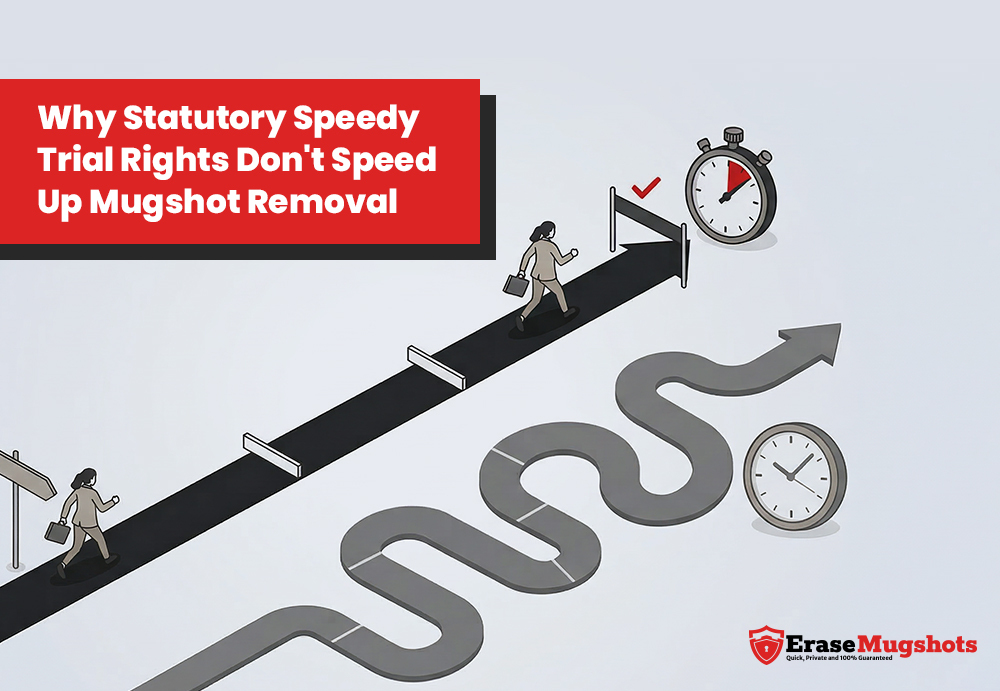
Table of Contents
If you’ve been arrested and you’re counting on speedy trial rights to get your mugshot off the internet, you’re working from a false assumption. It’s a common one—but acting on it wastes time and leaves your online reputation exposed.
Here’s what’s actually true: statutory speedy trial rights govern how fast your case moves through the court system. They have nothing to do with whether your booking photo stays online. Those are two separate legal tracks, and confusing them can cost you.
This article explains why and what actually works.
The Sixth Amendment guarantees the right to a speedy and public trial in all criminal prosecutions. Specifically, it states that in all criminal prosecutions, the accused shall enjoy the right to a speedy and public trial by an impartial jury, previously ascertained by law, in the state and district where the crime was committed.
The federal Speedy Trial Act—passed in 1974 and amended in 1979—put specific time limitations on that constitutional guarantee. Under federal law:
These rules apply to federal criminal proceedings. State laws vary, but most follow similar frameworks grounded in the Speedy Trial Clause of the Sixth Amendment and related case law.
The point of these rules is to prevent unnecessary delay between arrest and trial. They protect defendants, including those held in penal institutions, from being kept in pretrial detention indefinitely while the government prepares its case. They also serve the public interest—prompt disposition of criminal charges ensures fresher witness memories, better-preserved evidence, and a more efficient trial calendar.
What they don’t do: remove mugshots from the internet.
When a defendant claims their right to a speedy trial was violated, courts don’t apply a rigid formula. The Supreme Court’s decision in Barker v. Wingo (1972) established a four-part balancing test that trial courts still use today:
Courts weigh these factors together. No single factor is decisive. A very long delay might still not constitute a violation if the defendant never made a demand for a trial or suffered no real harm. Conversely, even a shorter delay can become a constitutional problem if the defendant’s assertion of the right was timely and the prejudice is clear.
If a violation is found, the case can be dismissed—sometimes with prejudice, meaning it can’t be refiled. But again: that outcome ends the criminal case. It doesn’t touch your mugshot.
Not every day between arrest and trial counts against the government. The Speedy Trial Act and most state speedy trial rules allow the following periods to be automatically excluded from the clock.
Common exclusions include:
The chief judge or trial judge oversees these determinations. A properly supported request for a continuance, with good cause shown and made on the court’s own motion or by a party, can significantly extend timelines. Courts must promptly advise defendants of their rights and any continuance granted.
Here’s the disconnect that catches people off guard.
When you’re arrested, law enforcement takes a booking photo. That photo becomes a public record. It gets logged into arrest databases. It gets picked up by third-party websites. And it stays there—regardless of what happens to your criminal case.
Even if your case is dismissed with prejudice due to a speedy trial violation, your mugshot doesn’t come down automatically. Courts evaluating speedy trial claims under Barker v. Wingo are focused on due process and criminal procedure—not your online reputation. There’s no mechanism in the Speedy Trial Act or the Sixth Amendment that reaches private websites hosting your booking photo.
This is true even in the clearest cases. If prosecutors violated the 70-day time limit, and the case gets dismissed, and the charges are wiped from your record, the photo can still be sitting on mugshot aggregator sites for years.
The speedy trial clock governs trial dates. It has no jurisdiction over the internet.
Because mugshot removal is entirely separate from criminal case outcomes, it requires its own process. Here’s how it generally works:
Expungement eligibility depends on your case outcome and your state’s laws. Generally, you may qualify if:
Not every case qualifies, and state laws vary significantly. Consult a criminal defense attorney who knows your jurisdiction.
This is a separate court filing—distinct from anything that happened in your criminal case. You file with the court where the charges originated. The petition must typically include documentation of your case outcome and a statement of why expungement is appropriate.
The prosecutor receives notice and may object. A hearing may be scheduled. The trial court then decides.
If granted, the court sets a formal order sealing or expunging your record. This is the document that carries legal weight with arrest databases and, in some states, with mugshot websites.
With the expungement order in hand, you (or your attorney) send formal takedown notices to the websites hosting your photo. Some states require sites to comply within a specific time frame. Others don’t, and enforcement is inconsistent.
Some sites comply quickly. Others ignore notices. When that happens, legal action may be necessary.
This isn’t a one-time fix. New sites can pick up your photo even after others remove it. Ongoing monitoring—manually or through a reputation management service—is often necessary.
Realistically, mugshot removal takes 30 to 90 days in straightforward cases. Complex situations—multiple sites, incomplete records, uncooperative platforms—can take much longer.
The expungement process itself moves at the court’s pace. Busy trial calendars, backlogged clerks, and scheduling delays all affect timing. Once you have the order, website response times vary widely.
An experienced attorney can speed things up by managing the process efficiently, following up with non-compliant sites, and escalating legally when needed.
This is an area where the law hasn’t fully caught up with the problem. Here’s the current landscape:
State expungement statutes are the primary tool. Many states—including California, Georgia, and Utah—have laws requiring mugshot sites to remove photos within a set period after a valid court order is presented. Georgia, for example, gives defendants a statutory right to demand removal under its expungement framework after qualifying case outcomes.
Federal law is limited here. The federal Speedy Trial Act (18 U.S.C. § 3161) and related provisions address criminal procedure timelines, not record removal. There’s no comprehensive federal law to takedown mugshots.
Section 230 of the Communications Decency Act has historically shielded websites from liability for third-party content—including mugshots. This protection makes it harder to force removal through civil litigation alone.
State-specific record sealing laws are the most direct path. If your state has a statute requiring compliance with expungement orders, that’s your strongest leverage.
“If my case is dismissed, my mugshot comes down.” No. Dismissal ends your criminal case. It doesn’t touch public records or private websites.
“A speedy trial violation means my record is wiped.” No. A speedy trial violation may result in dismissal of the case. Separately, you may then pursue expungement. These are two different processes.
“Once I get an expungement, all mugshots disappear.” Not automatically. You still have to notify each database and website. Some comply. Some don’t, and enforcement varies by state.
“Speedy trial rights protect my privacy.” The Speedy Trial Clause and the Due Process Clause protect your right to a fair and timely trial. Privacy protections for your online record come from expungement statutes—a body of law entirely different from the law governing your criminal record.
If your case outcome doesn’t qualify for expungement, or if you’re in a state with limited expungement options, you still have some paths forward:
Reputation management services use SEO strategies to push mugshot pages down in search results. They don’t remove the photo, but they can significantly reduce its visibility.
Direct negotiation with websites sometimes works, especially for smaller sites. Some will remove photos voluntarily, particularly if you can show the charges were dropped, or you were acquitted.
Civil litigation is a last resort for stubborn sites. This is expensive, and the outcome is uncertain, but in cases involving clear reputational harm, it may be worth exploring with an attorney.
State legislative remedies are expanding. More states are passing laws that give defendants stronger tools against mugshot sites. It’s worth checking what’s changed in your state recently.
If you’re serious about getting your mugshot removed, stop focusing on trial timelines and start focusing on what actually controls record removal: your state’s expungement statutes, and the steps required to enforce them.



We offer a total mugshot removal solution to remove your mugshot and arrest details from the internet once and for all.