

100% Satisfaction Guaranteed
We offer a total mugshot removal solution to remove your mugshot and arrest details from the internet once and for all.
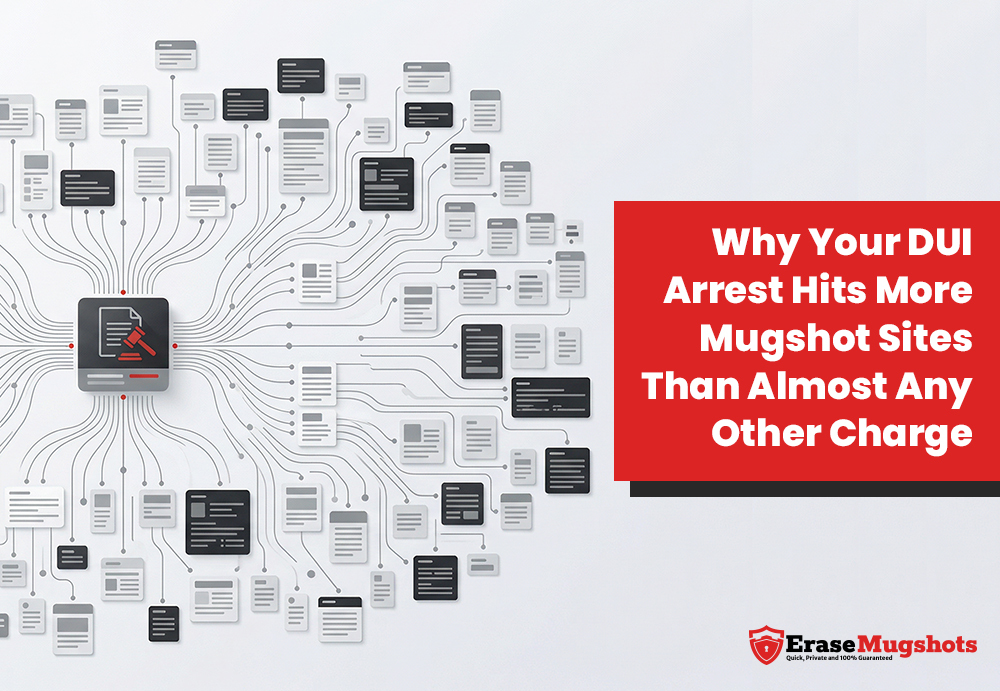
Table of Contents
If you’ve been arrested for driving under the influence, your mugshot is probably already on more than 50 websites. That’s roughly three times as many as someone arrested for theft or drug charges. It’s not random. There are specific reasons DUI arrests spread faster and stick longer than almost any other criminal offense.
Here’s what’s actually happening—and what you can do about it.
After a traffic stop, a law enforcement officer takes you to the police station for booking. That process creates a public record—your name, your photo, the charge. Agencies, such as local sheriff’s offices, are required to publish recent arrests for transparency.
Mugshot websites run automated scripts that scrape these public feeds daily. Within 48 to 72 hours of your DUI arrest, your photo can appear across dozens of private sites. You don’t get notified. You don’t give consent. It’s legal under current law because the booking record is public.
For a DUI offense specifically, that spread happens faster than almost any other charge. Here’s why.
DUI is one of the most common criminal charges in the country. More arrests mean more content for these sites to publish and profit from.
Drunk driving carries a social stigma that theft or drug possession often doesn’t. People search for it. Neighbors look up neighbors. Employers run checks. That traffic makes DUI mugshots more valuable to these sites.
Police departments and sheriff’s offices routinely share DUI arrest data through public feeds, press releases, and social media. A police officer suspects impaired driving, initiates a traffic stop, and the arrest becomes public record almost immediately. That visibility doesn’t apply the same way to quieter charges.
Around major holidays—especially the Fourth of July—law enforcement ramps up patrols for impaired driving. More arrests in a short window means a surge of mugshots hitting these sites at once.
DUI charges hit harder for people in regulated fields. A nurse, a commercial driver’s license holder, or a government contractor faces license and career consequences that make the need to find and exploit the mugshot feel even more urgent.
A DUI arrest triggers two separate processes at once.
You’ll face court dates and potentially a DUI conviction. Penalties for a first-time offense can include jail time of 1 to 3 days, fines of $500 to $2,000, mandatory alcohol counseling, and community service. A repeat offender faces significantly harsher criminal penalties, including longer jail time and felony charges, depending on the circumstances.
Separately, the DMV moves to suspend your driver’s license—often automatically. In many states, you have just 7 to 15 days to request an administrative hearing to challenge that suspension. Miss that window and your driving privilege is gone for months, sometimes years.
A DUI arrest is not a DUI conviction. The two processes are separate, and outcomes are not guaranteed.
You have constitutional rights during a police stop. Knowing them matters.
You’re not required to answer questions beyond identifying yourself. Slurred speech, your answers, and your behavior are all observations the arresting officer will include in police reports. Don’t give them more than required.
Standardized field sobriety tests—like the walk-and-turn or one-leg stand—are not mandatory for most drivers. However, if a police officer suspects impairment, they can still arrest you based on probable cause even without a completed test. An officer certified in these tests will document everything.
Under implied consent laws, if you’re arrested on DUI charges, you’re generally required to submit to a breath test, blood test, or urine test. Refusing a breathalyzer test or other chemical test typically results in automatic license suspension—sometimes longer than what you’d get from a DUI conviction itself.
After arrest, contact a DUI defense attorney as soon as possible. If law enforcement violated your constitutional rights during the stop or booking, an unlawful arrest argument could result in evidence being thrown out. A DUI defense attorney can review the blood alcohol content results, the portable breath test data, the arresting officer’s conduct, and whether probable cause was actually established.
The terms DUI and DWI—driving under the influence versus driving while intoxicated—are used interchangeably in some states. In others, DUI refers to impaired driving from alcohol or other drugs (including prescription drugs), while DWI refers specifically to alcohol. Some states use the term “called driving while impaired” or similar language.
For mugshot sites, the label doesn’t matter. Any driving under the influence arrest results in a booking record, which becomes public.
These sites don’t post your photo out of civic duty. They run a business.
The model works like this: they scrape public arrest records for free, post the photos, and then charge you to remove them. Removal fees often run into the hundreds of dollars. Pay-per-view features let anyone access your full booking details for a small fee. Even after you pay, copies may already exist on other sites.
And the photos don’t come down on their own. Even if your DUI case ends with dropped charges or a case closed outcome, most mugshot sites won’t update or remove your photo without a direct request. A DUI conviction staying on your record for years is bad enough—but these sites make the arrest itself permanent, regardless of the outcome.
Not automatically. Expungement may seal your official court records and could help restore a driver’s license or professional license, but it doesn’t force private websites to take anything down. These sites aren’t connected to the court system.
What can actually help is working with a DUI attorney who understands how to send legal takedown requests, file complaints under applicable state laws, and pursue photo removal on your behalf. Some states have passed laws requiring mugshot sites to remove photos without charging a fee—but enforcement is inconsistent, and not every site complies.
Act fast: The longer a mugshot stays up, the more copies appear elsewhere.
Don’t pay removal fees directly: Paying these sites rewards the behavior and doesn’t guarantee results.
Consult a DUI defense attorney early: They can address both your criminal case and your mugshot exposure. On the criminal side, they can challenge the traffic stop, the field sobriety tests, the breathalyzer test results, or the establishment of actual physical control of the motor vehicle. On the reputation side, they can pursue photo removal through legal channels.
Request your own records: Filing an open records request lets you see exactly what’s been published and by whom.
Check official sources instead: Court calendars, sheriff’s office websites, and justice court records give you accurate information without feeding traffic to exploitative sites.
A DUI arrest generates a public record fast. Law enforcement publishes it. Mugshot sites scrape it. And because drunk driving carries both high public interest and real professional consequences, your photo spreads further and faster than almost any other criminal charge.
You have rights during the arrest, options in the court process, and legal paths to address the mugshot problem. The key is acting quickly on all three fronts—before a prospective employer, a licensing board, or anyone else finds it first.
If you’ve been arrested for driving under the influence, talk to a DUI defense attorney before you plead guilty, pay any fees, or assume the process will resolve itself.



We offer a total mugshot removal solution to remove your mugshot and arrest details from the internet once and for all.