Table of Contents
This article explains the process of accessing the State of Florida arrest records, which can give you a better understanding of your online reputation.
Due to flexible public records laws in Florida, criminal history information is surprisingly easy to find there, even if you’re a member of the public with no law enforcement connections. And while that may be helpful if you’re trying to find information on someone else, it’s daunting if you know your own criminal records are available for anyone to see.
Even worse is that it’s easy for third-party websites to pull information from official databases. From there, those sites can rank highly in Google search results. Then, if someone Googles your name, they may be able to see information about your criminal history without ever visiting an official site.
If you’re trying to get a handle on your online footprint, knowing what’s on your arrest record is imperative. In this article, we’ll go over everything you need to know about requesting Florida arrest and criminal records online.
Do you need immediate help removing your arrest records and mugshots from the internet? Get in touch with us at 866-601-6803 today.
Where Can I Access Arrest Records in Florida?
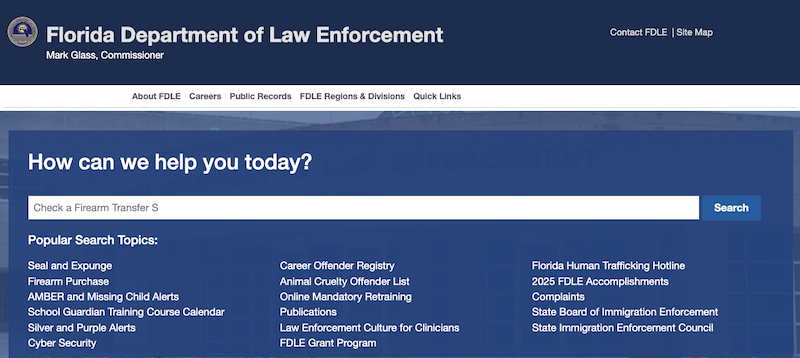
In the state of Florida, arrest records are made public and can be accessed via the Florida Department of Law Enforcement, or FDLE. This department is part of the Criminal Justice Information Services (CJIS) and maintains criminal records for the entire state. According to the website, the FDLR “is the central repository for criminal history information for the state of Florida.”
In addition to having a database of criminal history information, the Florida Department of Law Enforcement also gives the public access to this information upon request. However, there are required fees for record checks.
3 Ways To Request Florida Criminal Records

The Florida Department of Law Enforcement provides three options for requesting criminal history information: instant search, certified or non-certified search, and ORI search. Let’s go over each one.
Instant Search (Self-Service)
This type of internet search is conducted by the public. Results are immediately available, and they will not be certified.
You’ll get a list of up to five possible matches that are similar to your inquiry. You’ll review the list to determine if any of the candidates match who you’re looking for. It’s also possible your search won’t return any candidates. The more accurate the information you provide, though, the better chance you’ll have of finding the right individual.
Results can be emailed to you, or you can print them out.
Instant searches cost $24 each. There’s also a $1 credit card processing fee. That $25 total fee is charged regardless of your search results — it’s the cost for searching, not a guarantee of results. If your search returns more than one result and you want records for additional subjects, you’ll be charged $25 fee for each additional person you select.
Certified or Non-Certified Search
With this type of Florida records search, the customer provides demographic information to Florida Department of Law Enforcement staff, who then perform the search. Here’s how the process works:
- Provide the mailing address where you want to receive the results.
- Enter demographic information for the search subject. Multiple subjects can be included in a request, and you can enter up to 10 aliases per search subject.
- Review and confirm the information you provided. You’ll be able to edit any information before submitting.
- Indicate whether or not you want the results certified.
- Enter your payment information and complete the transaction. This type of search costs $24.
These results can be notarized, and customers receive the records by mail. Non-certified results are processed in 5 business days, and certified results are processed in 6-7 business days. Keep in mind that mail delivery time is in addition to the Florida Department of Law Enforcement’s processing time.
ORI Search
An Originating Agency Identifier (ORI) search requires a valid ORI order. An ORI search order is a nine-character code that’s assigned by the Department of Justice (DOJ) or the FBI to authorized agencies.
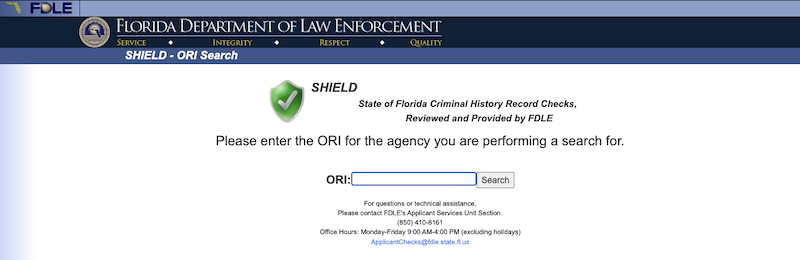
The cost of this type of search varies based on who’s authorized and state guidelines. Results go directly to the ORI-authorized recipient.
The Florida Department of Law Enforcement cannot provide ORI numbers. If you are conducting a criminal record check and need an ORI number, you have to contact the appropriate agency or entity to supply a valid code.
7 Reasons Why Your Records Search May Have No Results
There are a number of reasons why your Florida criminal records search may not return any results:
- The subject has never been arrested or had their fingerprints taken for a serious offense in the state.
- A Federal agency arrested the subject.
- The record is sealed or expunged.
- There are laws preventing access to a juvenile’s criminal history, even if the records haven’t been sealed or expunged.
- There was never a criminal fingerprint card submitted to the Florida Department of Law Enforcement by the arresting agency.
- While the person’s fingerprint card was sent to the Florida Department of Law Enforcement, there was an error, and it either hasn’t been received or hasn’t been entered into the system yet.
We work on behalf of our clients to erase mugshots, arrest records, police reports and other sensitive information from the internet. Give us a call at 866-601-6803 to learn more.
How Accessing Florida Arrest Records Can Help Your Online Reputation

Understanding what appears online about you — in your arrest record and on Google — is necessary for managing your online reputation.
Florida has broad public records laws, and your sensitive information is accessible to anyone willing to pay the fee. From there, your arrest information can be picked up by data brokers and other third-party websites, then spread around the internet so it surfaces in Google results.
Often, people don’t even realize that their criminal history records are circulating online — until it impacts their personal or professional life.
By accessing your arrest records, you’ll find out what information is publicly available. You’ll also be able to check if the information online is accurate. For example:
- Is your case information incomplete?
- Do the records reflect expungements or dropped charges?
- Are there errors that are impacting your reputation?
When third-party sites pick up public records, they don’t always update them as your case evolves. That means that misleading and out-of-date records may exist on people-search websites and other platforms.
Once you have a handle on where your personal information appears online, you can take steps to update, remove or suppress it. You may even decide that you want to take steps to seal or expunge your record for more control over what the public has access to. Getting your record sealed or expunged won’t immediately remove it from online sources, but it does give you a much better case when you contact those sites to take down the information.
When you take time to review your public Florida arrest records, you take control of the online narrative connected to your name. From there, you can move forward and build a cleaner online presence.
FAQ About State of Florida Arrest Records
Can you request Florida criminal records by mail?
No, you can’t request Florida criminal history records by mail. As of July 2020, the Florida Department of Law Enforcement discontinued mail request forms.
What payment options does the Florida Department of Law Enforcement accept when requesting records?
When requesting Florida criminal history information, you can pay the required fee by credit or debit card. The fee is due when you make the request.
Can I see the subject’s Social Security number on the records?
No, the FDLE will not release a subject’s complete SSN. Only the last 4 digits of the SSN will be visible.
Wrapping Up
Gaining access to your arrest records gives you clarity and control over your digital footprint. Instead of guessing what information may be online about you, this will show you exactly what’s available. You can then consider how it’s impacting your online present and what your next steps should be.
Do you need help removing your arrest records and mugshots from search results? Get a free mugshot removal analysis today and sign up for a consultation with one of our experts. Learn more here or call
866-601-6803
to speak with a member of our team.
See What Shows Up When Someone Searches Your Name
Get a free, no-obligation analysis of your exposure — mugshots, arrest records, and everything else a background check might turn up.