Table of Contents
When people see a mugshot appear online, they often assume the arrest caused it. That assumption is wrong.
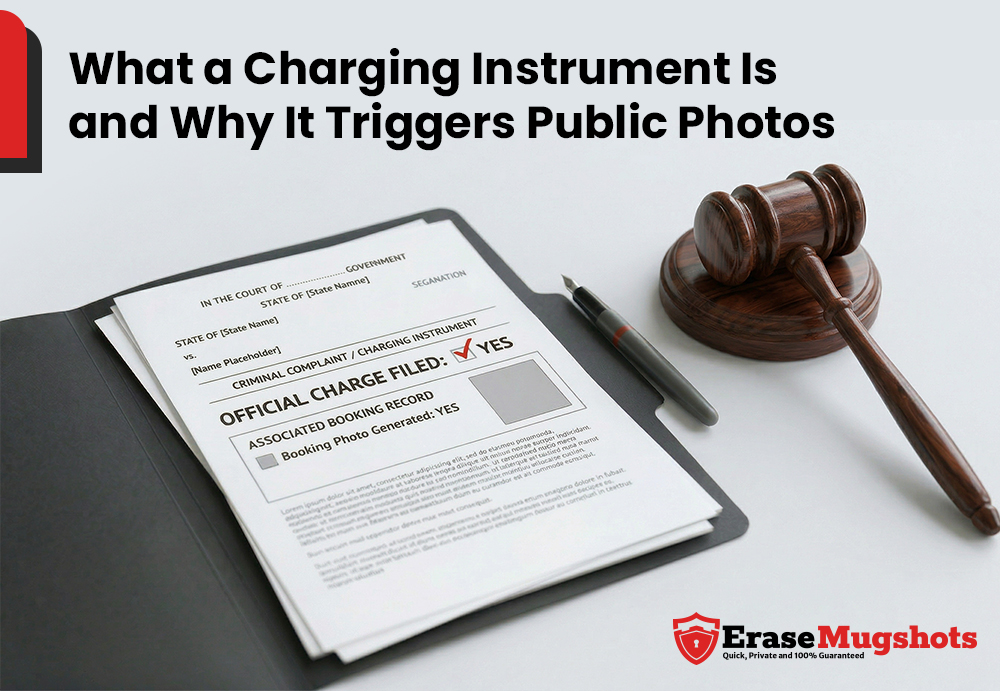
In most criminal cases, public photos are not triggered by an arrest alone. They appear when the government files a charging instrument. That single procedural step changes a case from a police matter into a public court proceeding.
Understanding that distinction matters. It explains why some arrests stay quiet while others become searchable overnight.
What a Charging Instrument Actually Is
A charging instrument is a formal legal document that starts a criminal case in court. It tells the defendant, the judge, and the public what crime the government claims was committed and under what statute.
In criminal law, a charging instrument takes one of three forms:
- Criminal complaint
- Criminal information
- Indictment
Each serves the same purpose: to establish probable cause, initiate prosecution, and provide notice of the alleged offense.
Until one of these documents is filed, there is no criminal case—only an investigation or arrest.
The Three Types of Charging Instruments
Criminal Complaint
A criminal complaint is usually the first document filed. It is a sworn statement, often written by a police officer, laying out the essential facts of the alleged crime.
- Filed to support an arrest warrant
- Must establish probable cause
- Common in misdemeanor cases and early felony proceedings
- Can place a person into custody and trigger bail
A complaint alone may not make photos public, depending on jurisdiction and local court rules.
Criminal Information
A criminal information is filed by a prosecutor without a grand jury vote.
- Used to initiate prosecution more quickly
- Common in misdemeanor cases and some felony cases
- Presented to a judge rather than a jury
- Must still provide sufficient notice of the charged offense
Because it formally opens a criminal case, filing an information often makes booking photos and court records public.
Indictment (Grand Jury Indictment)
An indictment is the most significant charging instrument.
- Requires a grand jury vote
- Used for felony cases
- Constitutionally required in federal felony prosecutions under the Fifth Amendment
- Formally accuses the defendant of a crime
Once a grand jury indictment is filed with the trial court, the case becomes a public proceeding. That filing—not the arrest—is what typically triggers the release of mugshots and court records.
Why Filing a Charging Instrument Makes Photos Public
Courts operate under the principle of open justice. When a charging instrument is filed:
- The case enters the judicial system
- The court gains jurisdiction
- The defendant receives formal notice
- The public gains the right to observe the proceedings
At that point, booking photos, case numbers, and allegations become public records, unless a statute or court order restricts access.
This is why two people can be arrested under similar circumstances, but only one appears online. The difference is whether the prosecutor has formally charged the case.
Arrest vs. Charge: The Line That Matters
An arrest places a person in custody.
A charging instrument places a case before a court.
Police can arrest someone based on probable cause. Prosecutors must decide whether there is sufficient evidence to file charges. That decision determines whether the case becomes public.
No charge means no public prosecution.
A filed charging instrument means public exposure.
What Charging Instruments Must Contain
A valid charging instrument must:
- Identify the defendant
- Allege a specific offense under the law
- Describe the conduct alleged
- Provide enough detail for the defendant to prepare a defense
It does not need to prove guilt. It must only establish that a crime was allegedly committed and that the prosecution has sufficient evidence to proceed.
Courts have repeatedly held that an indictment does not fail simply because it omits certain details, as long as it provides adequate notice.
Errors, Amendments, and Objections
Charging instruments are not perfect. Prosecutors work under time pressure and high caseloads. Mistakes happen.
Texas courts, including the Court of Criminal Appeals, allow prosecutors to:
- Amend indictments to correct errors
- Substitute corrected copies
- Remove surplus language that does not affect the offense
However, defendants must act quickly.
If a charging instrument is defective, the defense must file a motion to quash before trial. Failing to object can waive the issue on appeal, even if the indictment contains flaws.
Courts apply a harm analysis. If the defendant had actual notice and suffered no prejudice, a conviction may still stand.
Why Early Review Matters
Errors in charging instruments are easiest to fix early. Once the trial begins, options narrow.
Defense lawyers scrutinize charging documents because:
- A missing mental state can weaken the prosecution
- Incorrect offense language can affect punishment
- Variances between allegations and evidence can create appeal issues
Prosecutors review them to avoid dismissals, delays, or reversals.
Everyone involved treats the charging instrument seriously because it defines the case.
What This Means for Defendants and the Public
If a photo appears online, it usually means:
- A charging instrument was filed
- A prosecutor made a charging decision
- The case entered the court system
- The proceedings became public
It does not mean:
- The person is guilty
- The evidence is overwhelming
- A conviction is inevitable
It means the legal process has formally begun.
Why This Distinction Matters
Charging instruments sit at the center of criminal procedure. They mark the moment when allegations become public, and reputations are affected.
Understanding that moment helps explain:
- Why do some arrests disappear quietly
- Why do others follow people for years online
- Why timing and procedure matter as much as facts
In criminal law, the filing of a document—not the arrest—changes everything.
See What Shows Up When Someone Searches Your Name
Get a free, no-obligation analysis of your exposure — mugshots, arrest records, and everything else a background check might turn up.