Table of Contents
The short answer: “mug” became slang for a person’s face. Police adopted the term for the face photos they take at booking. Here’s a look at where the word came from and how mugshots work today.
If you or someone you know has ever been arrested, you’ve probably seen a mugshot, also called a booking photo, attached to that arrest record. A mugshot doesn’t prove guilt. It doesn’t mean the person now has a criminal record. It’s a standard step in the arrest process, and law enforcement officers follow it in every state in the U.S.
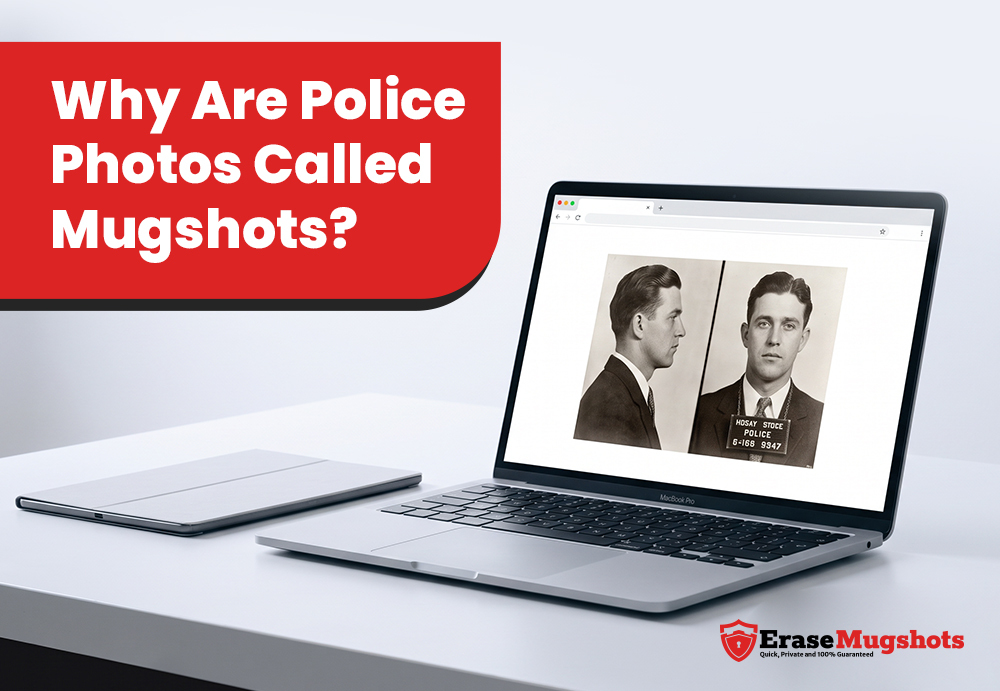
A typical mugshot includes two images: one straight-on shot of the full face, and one side profile.
Police take mugshots for a few practical reasons. The photo helps identify a person, lets officers share that identification with other law enforcement agencies, and documents the person’s condition at booking, including any visible injuries. Below, we’ll cover the history behind the term, how police use mugshots, and why these images can still follow someone online long after an arrest, affecting their reputation and job prospects.
A Mugshot Isn’t Proof of Guilt
State law typically requires photographs at the time of arrest, regardless of the reason. The photo establishes the suspect’s identity. Every mugshot includes a booking number and the arrest date. The person may never face charges, yet the mugshot remains on file as a public record. Even someone later convicted keeps that same mugshot in the public domain.
A Quick History of the Mugshot
Police began photographing arrested people in the mid-19th century, shortly after photography became practical. U.S. police began taking mugshots in the 1850s. A clerk at the Prefecture of Police in Paris created the format most people recognize today: one front-facing shot and one side view, placed side by side.
French anthropologist Alphonse Bertillon standardized the process in the 1880s with what became known as the Bertillon System. He combined front and profile photographs with detailed body measurements and a description method called portrait parlé, which included measurements such as the head’s length and breadth. Officers used his system to track and identify repeat offenders, and it helped identify 241 recidivists in 1884 alone. It shaped police identification practices well into the 20th century.
English police, including those near Wormwood Scrubs Prison, adopted photo identification too. It gave them a far more reliable tool than the wanted posters they’d used before. Departments compiled these photos into physical rogues’ galleries throughout the 19th and early 20th centuries. This practice predates the word “mugshot” itself. The New York City Police Department published its own booking photo guidelines in 1908.
How U.S. Police Departments Adopted the Practice
The Bertillon System went on display at the Chicago World’s Fair in 1893. American urban police departments picked it up soon after, folding it into a broader push to improve criminal identification. Camera technology kept improving too, which made standardized booking photos easier to produce and share between departments. Digital photography later further sharpened image quality and made the whole process faster.
Where the Word “Mug Shot” Comes From
Historians trace the term back to the Scandinavian word “mugg,” meaning a drinking vessel or cup. In the 17th and 18th centuries, people decorated mugs with cartoonish human faces. Over time, “mug” came to mean an unattractive face.
The word eventually worked its way into police jargon, and crime movies from the 1930s helped popularize it. In the UK, “mug” was slang for a person, similar to how the British use “bloke,” often with a slightly low-class connotation. Thieves also used “mug” to describe someone with a criminal record, and that usage stuck.
The Lasting Damage a Mugshot Can Cause
You don’t have to be guilty of anything for your mugshot to show up in a simple web search. That alone can feel embarrassing, and in worse cases, it can seriously damage your reputation. Some mugshots even take on a life of their own culturally. A single photo of someone in an orange jumpsuit, looking disheveled, can shape how strangers see that person for years.
Once people find your mugshot, they start asking questions: Is that really you? Why were you arrested? What did you do? Did you serve time?
Many people end up paying to have these photos taken down just to avoid that kind of scrutiny and the fallout it brings to their career and personal relationships. High-profile cases show how far this can go. Some of history’s most recognizable mugshots, including those of Rosa Parks and Martin Luther King Jr., became symbols of the civil rights movement rather than markers of guilt. Donald Trump became the first former U.S. president to have an official mugshot taken. Unlike a paparazzi photo, a mugshot carries an implication of wrongdoing that can reshape how the public views someone, regardless of the outcome of their case.
How Mugshot Sites Turned Public Records Into a Business
Because mugshots are public record, anyone can pull them from a police department’s website and repost them elsewhere. That’s exactly what happened starting in the early 2010s, when the online mugshot industry took shape.
More than 80 sites, including names like BustedMugshots and MugshotsOnline, now host large collections of booking photos. They post images of celebrities, business owners, everyday people, and often target individuals who were merely accused of a crime, not convicted of one. Then they charge for removal, with fees ranging anywhere from $19.90 to over $1,000. Critics have called this an extortion racket, and several states have made the practice illegal, with real fines attached. Sites that don’t charge for removal often make their money through advertising instead.
States Are Starting to Push Back
Lawmakers have taken notice. Illinois now requires redaction of mugshots and booking information in many cases. San Francisco police stopped publishing mugshots altogether in 2020. Law enforcement generally frowns on using booking photos for profit. The original purpose of a mugshot is identification, not a revenue stream built on public shame.
How Reputation Management Firms Help
Professional online reputation management firms help people get mugshots taken down, either by negotiating directly with website owners or by pursuing legal removal channels. These firms also build positive content to push negative results further down the search page. That work got a boost in 2013, when Google updated its algorithm to downgrade mugshot sites in search rankings.
If you’re dealing with a mugshot online and want help getting it removed, NetReputation’s EraseMugshots team can walk you through your options. Call 866-601-6803 to learn more.
See What Shows Up When Someone Searches Your Name
Get a free, no-obligation analysis of your exposure — mugshots, arrest records, and everything else a background check might turn up.