Table of Contents
Most people think mugshots live on the internet because of websites. However, that’s only part of the story.
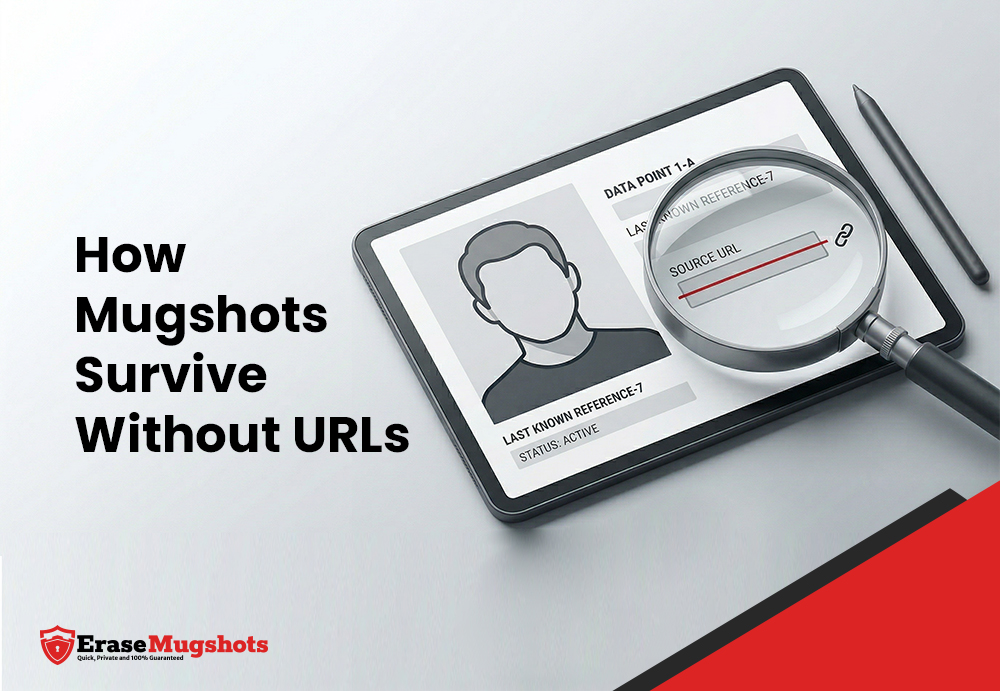
Even if every mugshot site disappeared tomorrow, most mugshots would still exist. They wouldn’t be online, indexed, or clickable, yet remain public and accessible.
This is because mugshots don’t depend on URLs to survive.
Mugshots Exist Before the Internet Ever Touches Them
A mugshot is created the moment a person is booked. It serves as a standardized photograph for identification, documentation, and recordkeeping. Long before a website copies it, that image enters a government system.
Police departments retain booking photographs as part of arrest records, while courts maintain copies alongside case files. Public records offices store them according to retention schedules that often span decades.
None of this requires a website, Google, or a search result.
Therefore, mugshots persist even when online removal succeeds.
Public Records Keep Mugshots Alive Offline
In most U.S. jurisdictions, mugshots are considered public records. Although access rules vary, availability is generally the default.
People can request mugshots directly from:
- Police departments
- Sheriff’s offices
- Court clerks
- Records divisions
Requests may be submitted in person or online through government websites. Some agencies provide forms that let you save your form progress and manage notification subscriptions to track your request status. Others may need to press a button to begin the application process. Additionally, some agencies charge fees payable by cash or other methods. Whether digital or physical, the image exists independently of the web.
For those needing assistance, contact information is usually available on official sites to help guide the process of requesting mugshots or related information with care and accuracy.
This explains why expungement helps but doesn’t erase everything. Unless a court specifically orders destruction, the original record often remains archived.
Newspapers and Print Media Extend Their Lifespan
Long before mugshot websites existed, newspapers ran arrest photos.
Weekly blotters, Friday crime roundups, and front-page images after high-profile arrests were printed, distributed, and archived in libraries—some still are.
Once printed, a mugshot cannot be “taken down.” It can be scanned, photocopied, reposted, or rediscovered years later.
Many news organizations have stepped away from large mugshot galleries because of the harm they cause. Nevertheless, the old copies still exist and don’t require URLs.
Mug Books Never Went Away
Police have long used physical “mug books”—binders, filing cabinets, and photo arrays —for identification.
These books still sit in stations and records rooms, indexed by name, date, or booking number. Anyone with lawful access can view them.
No clicks, no loading bars, no form progress, no save buttons—just photographs.
Why Online Removal Doesn’t Feel Like the End
For-profit mugshot websites exploit public records by copying them and charging people to remove the images. Many states now ban this practice, recognizing it as legalized extortion.
Even when a site complies:
- The source record remains
- The photo still exists offline
- Copies can be requested again
This is why removal often feels temporary. You didn’t erase the mugshot; you removed one reproduction of it.
The Ethical Conflict No One Wants to Own
Mugshots create a visual narrative of guilt before due process finishes. They shape perception faster than words ever could.
Even when charges are dropped, cases dismissed, or someone later exonerated, employers see them, landlords see them, and communities remember them.
The law prioritizes transparency, but the damage lands on individuals.
That tension remains unresolved.
Why URLs Became the Wrong Target
Modern reputation strategies focus on search engines—push this down, de-index that, suppress results.
While those tactics matter, they miss the deeper problem.
Mugshots survive because they are records, not content. They are preserved because systems were built to keep them. They persist because no law requires their destruction.
URLs didn’t create this problem; they just made it visible.
What Actually Limits Mugshot Spread
The only factors that truly reduce long-term exposure are:
- Court-ordered sealing or expungement at the source
- Policy changes limiting release for nonviolent arrests
- Media restraint
- Stronger public-record reform
Everything else is containment—necessary, useful, but incomplete.
The Reality Going Forward
Accessibility laws, evolving privacy standards, and public pressure are forcing change. Some states now restrict posting mugshots for certain offenses. Newsrooms are rethinking galleries. Courts are tightening access.
Many websites have implemented arrow slideshows and right slideshow features to organize mugshot galleries responsibly, allowing users to navigate with an arrow rather than overwhelming them with images.
Users can read detailed information about each arrest with care, ensuring that browsing mugshots is informative rather than sensational.
However, the underlying system still assumes permanence.
That’s why mugshots don’t need URLs to survive and why removing them from the internet is never the same as removing them from existence.
See What Shows Up When Someone Searches Your Name
Get a free, no-obligation analysis of your exposure — mugshots, arrest records, and everything else a background check might turn up.